

Past Editions
A retrospective overview of past editions of the Light Leaks Festival —
from its origins as a Slide Night to an international photography festival.
Talks by invited photographers such as Dirty Harrry, Brice Gelot, Myriam Boulos and Gabrielle Duplantier formed the central framework of the programme, alongside workshops, portfolio reviews and photowalks that encouraged direct exchange between artists, participants and audiences. The Open Wall, Youth Contest, Bazaar and Book Market further reinforced the festival’s collaborative and participatory spirit.
Throughout the weekend, exhibitions and activities transformed the Rotondes into a place of dialogue, discovery and experimentation, bringing together emerging photographers, established artists and visitors around a shared curiosity for the image and its many possibilities.


Festival Conversations
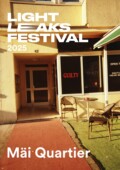
Talks by the invited speakers formed the intellectual backbone of the edition, while workshops and portfolio reviews encouraged close exchange between photographers and audiences. Installations such as the Cube and Loop, outdoor exhibitions by members of the collective, and the “Mäi Quartier” project created multiple layers of engagement across the district.
Contributions from students of Lycée Aline Mayrisch and Lycée des Arts et Métiers, alongside a curated selection from the Photothèque’s archive, reinforced the festival’s commitment to dialogue between generations, practices and memories.



A one-day Masterclass led by Michael Ackerman offered an in-depth exploration of personal vision and photographic language, creating a rare moment of concentrated exchange.
The introduction of the Bazaar expanded the festival’s format beyond exhibition and talk, establishing a space where artists could present, discuss and circulate their work directly — reinforcing the festival’s commitment to dialogue, accessibility and community.


While rooted in street photography, the rebranded festival embraced a broader engagement with storytelling across street photography, photojournalism and documentary practice — reflecting an increasing interest in narrative depth, social context and long-term projects.
The edition also introduced the festival’s first large-scale outdoor exhibition, presenting monumental prints by Tatsuo Suzuki and Graciela Magnoni. Installed in public space, the works extended the festival beyond its interior venues and reshaped how audiences encountered photography — direct, immersive and unmediated.
The new name signalled not only a shift in focus but also a maturation of the festival’s curatorial direction, positioning Light Leaks as a platform for contemporary photographic storytelling in its wider sense.


For the first time, the festival collaborated with the Lycée des Arts et Métiers, integrating student contributions into the public programme and reinforcing its commitment to intergenerational exchange and transmission.
In the same year, the collective expanded its podcast series Streets Unplugged. What had begun with conversations featuring local photographers evolved to include recorded discussions with invited guest speakers, extending the dialogue beyond the exhibition space and contributing to a growing archive of photographic thought and practice.


With Benita Suchodrev, Giacomo Sini and Jane Evelyn Atwood, the festival brought together three distinct documentary voices whose practices span intimate portraiture, socially engaged street work and long-term humanistic observation. Their talks reflected a renewed appetite for direct dialogue — between photographer and audience, and between image and lived experience.
For the first time, the programme was officially extended by an additional day, allowing for an expanded schedule of workshops and portfolio reviews. This structural shift strengthened the festival’s educational dimension and deepened its commitment to fostering critical exchange and mentorship within the photographic community.


Vlad Eftenie, Joe Aguire, Pierre Gély-Fort and Gil Rigoulet presented their work through online lectures that reached audiences beyond Luxembourg, expanding the festival’s geographic scope in unexpected ways. Though separated physically, the exchange of ideas remained central.
Portfolio reviews were conducted virtually, maintaining one-to-one encounters between photographers and mentors, while a digital Open Wall invited broader participation and community involvement.
Despite the absence of shared physical space, the 2020 edition demonstrated the resilience of both the festival and the photographic community, affirming that critical exchange and creative connection could persist beyond institutional walls.


With Cyrus Cornut’s long-term engagement with underground music culture, Sabine Weiss’s humanist legacy, Pierre Gély-Fort’s curatorial insight and Vanessa Winship’s poetic documentary practice, the programme offered a broad spectrum of photographic approaches — spanning intimate observation, social landscape and personal narrative.
Crucially, 2019 also saw the festival’s first large-scale exhibition presented in the dedicated exhibition gallery at Rotondes. Moving into this professional exhibition space represented a significant step in scale and ambition. Photography was no longer only encountered through projection or modest installations, but within a fully realised gallery environment that allowed for sustained viewing and curatorial coherence.
The extended format created space for deeper exchange through lectures and discussion, while the exhibition component affirmed the festival’s growing institutional confidence. By this stage, the Luxembourg Street Photography Festival had firmly established itself as a recurring platform for critical reflection on street and documentary photography, attracting both international contributors and an expanding local audience.


Their participation underscored the festival’s expanding international reach and strengthened its curatorial profile.
The presentation of works within the space became more deliberately structured, creating a clearer spatial dialogue between image and viewer. While still intimate in character, the 2018 edition signalled that the visual dimension of the festival was becoming as significant as the talks themselves — laying the groundwork for the more exhibition-driven editions that would follow.


For the first time, the Luxembourg Street Photography Festival welcomed an invited international speaker. Jean-Christophe Béchet’s presence broadened the scope of the event, connecting the local photographic community with a wider European context and introducing a stronger critical dimension to the discussions.
Alongside the talks, selected works by members of the collective were presented within the venue, offering audiences an opportunity to encounter the images beyond projection. Though modest in scale, this gesture reflected the festival’s growing confidence and emerging curatorial awareness.


The move to Rotondes proved to be a defining step. As a cultural institution with an established programme, professional infrastructure and technical expertise, Rotondes became a trusted partner in shaping the festival’s format and ambitions. Their location, support and know-how provided the conditions necessary for the event to evolve beyond an informal gathering into a sustained annual platform.
With the introduction of an outdoor exhibition and the Open Wall, the programme expanded beyond projection and presentation, creating a visible presence in public space and inviting wider participation. These additions established a balance between curated contributions and open engagement — a dynamic that would continue to define the festival’s identity in the years that followed.
The 2016 edition laid the groundwork for the festival’s continued growth and consolidation within Luxembourg’s cultural landscape.


The evening maintained its focus on shared projection and exchange, but the new context provided increased visibility and professional infrastructure. This collaboration offered the structural support that would soon enable the event to grow beyond its slide-night format.
While still modest in scale, the 2015 edition signalled a clear transition: from an independent grassroots gathering to a project capable of developing into a recurring cultural event.


While the format remained intimate and centred on projection and discussion, the 2014 edition demonstrated that the initial experiment of the previous year was not an isolated occurrence but the beginning of a developing platform. The continuity between editions strengthened the sense of community and hinted at the potential for further expansion.


What began as an informal gathering for sharing images quickly revealed a genuine appetite for collective viewing and discussion. The atmosphere was spontaneous and experimental, yet already driven by a clear desire to create a space where street photographers could come together, present their work and engage in open exchange.
Though small in scale, the 2013 Slide Night established the essential spirit and communal foundation upon which the festival would continue to grow.


